Night Luck
8.2/10Casino welcome bonus 805% up to €6,400 + 280 FS
- MuchBetter · VISA · Apple Pay
- Crypto welcome 140% up to 1,600 USDT
- VIP pack 800% up to €14,500
Terms move often. Verify on the operator's own page.
Prizes costed, terms shown
18+. Wagering is risky. Only ever stake what you can afford to lose.
A Visa debit deposit clears in minutes and the payout returns inside one to three banking days at a typical cashier. This page costs the default rail against the wallets, transfers and vouchers that sit beside it, so the waiting is priced before the deposit is made.
The board on this page is an editorial comparison, not a live feed. Terms move often, so treat every line as a starting point and verify the current offer on the operator's own page before any money moves.
Casino welcome bonus 805% up to €6,400 + 280 FS
Terms move often. Verify on the operator's own page.
Welcome bonus €/£5,000 + 500 FS
Terms move often. Verify on the operator's own page.
Welcome pack €5,000 + 500 FS + €650 free bet
Terms move often. Verify on the operator's own page.
Welcome package 300% up to €/£1,000 + 150 FS
Terms move often. Verify on the operator's own page.
On this page
Visa debit is the rail most British-facing cashiers treat as the default. The card logos at the deposit screen start with it, the form is built around it, and the minimums are set with it in mind. That position is not an accident: debit cards sit in the majority of UK wallets, the authorisation runs in seconds, and the money leaves the bank account as the transaction clears rather than on some later billing date.
Default status cuts both ways. Because the rail is everywhere, it becomes the baseline every alternative is measured against. An e-wallet advertises faster payouts, a bank transfer advertises higher ceilings, a prepaid voucher advertises spending control, and each claim only means something once the debit card’s own numbers are on the table. That is the job of this page: take the default rail, attach the usual windows and the usual terms, and cost the result from the deposit to the payout.
Availability reaches the small end of the market too. A five pound cashier, a bingo-first room, a slots specialist: nearly all of them take Visa debit, and a lobby that refuses the card usually says something about its payment strategy that the rest of its terms only hint at. That ubiquity also keeps the cashiers honest about minimums: a card accepted everywhere competes with rails advertising lower floors, and the competition shows up as five and ten pound minimums rather than twenty. Where an operator trims the rails to a short list, the card that survives the cut is most often this one.
One habit makes the rail more useful than it looks. Visa debit spending lands on the bank statement in real time, so a month of deposits reads as a dated, unbroken record. That record is the cheapest budgeting tool in gambling: it shows the pattern without an app, and it gives the deposit limits set in the account something to be checked against at the end of every week.
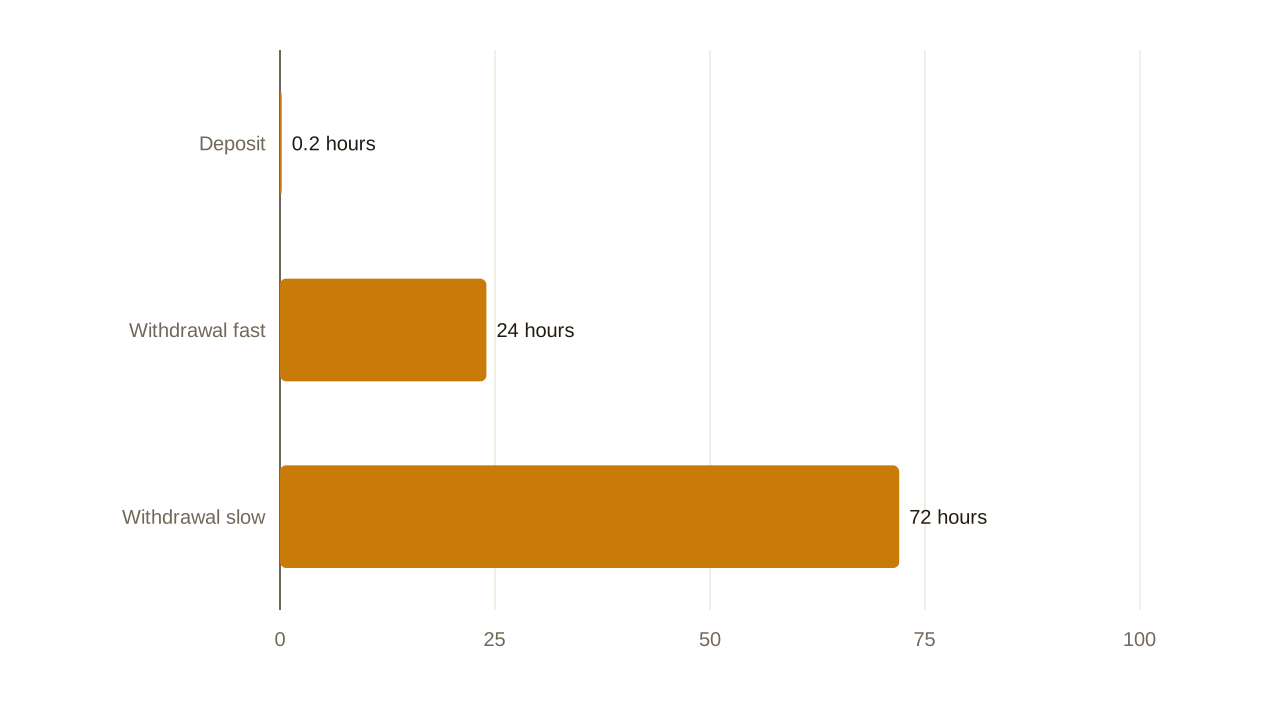
Speed is the rail’s strongest suit. A Visa debit deposit authorises in seconds: the cashier sends the request, the bank verifies it, often through a 3D Secure step in the banking app, and the balance updates before you have left the deposit screen. The model on this page allows 0.2 hours for the whole trip, about twelve minutes once reaching for the card, typing the details and approving the check are counted in. Nothing else in the payments world arrives faster except the other instant rails, and most of those need an account of their own first.
Fees barely feature. Cashiers at this end of the market almost never charge for a card deposit, and the bank does not charge for an authorised debit either. The real costs on this rail are the ones the bonus terms attach, not the ones the card attaches, which is why the worked example later on this page matters more than the deposit itself. A deposit that arrives free but buys into a 35 times wagering rule has not finished costing money; it has only started.
The twelve-minute band absorbs a failed attempt too. If the first authorisation fails on a mistyped expiry date or a missed approval, a second attempt usually completes inside the same window, so the model does not need to move. Only a bank-side block pushes a deposit past the band, and that is a deliberate refusal rather than a delay, which is the subject of a later section.
One caution sits alongside the speed. Instant in means the spending decision happens at instant speed as well, with no cooling-off gap between wanting the balance and holding it. Players who rely on friction to pace themselves should know the friction is absent by design. Deposit limits set in the account, or a gambling block set with the bank, restore the pause on request, and neither costs anything to run.
Withdrawals are where the debit default pays for its convenience. The model carries two bands: a fast band that clears inside 24 hours and a slow band that runs to 72 hours, which is three banking days once weekends drop out of the count. Most British-facing cashiers quote one to three banking days for a card payout, and the quote usually starts after a pending window that the account’s own terms set. The pending window is the part readers forget: many cashiers hold a request for a fixed period, sometimes to the next working day, before the banking clock starts, and the two delays stack rather than overlap.
Set the bands against the alternatives and the picture sharpens. E-wallets pay in hours once the account is verified, often inside the same day. Bank transfers run slower at three to five banking days, sometimes longer, and cost more in fees at some cashiers. Prepaid vouchers are the outlier: they take deposits but hold no exit rail at all, so a player funded by voucher must nominate a bank account or a card for the payout and run verification from scratch. The debit card sits mid-field: slower than a wallet, faster than a transfer, and always able to receive the money back.
The chart below plots the three bands on one axis, from the twelve-minute deposit to the slow 72-hour withdrawal. Read it as assumption bands rather than promises: the fast band assumes verification is already done and the payout leaves the pending queue quickly, the slow band assumes a manual review or a weekend in the way, and both assume the money returns to the card that funded the deposit. Where a cashier advertises a faster window, the difference usually lives in the pending period rather than in the banking leg itself.
Two practical details finish the picture. Withdrawals usually have to return to the source card, closed-loop by design, so the payout goes where the deposit came from, and a card that has expired since the deposit forces a bank-transfer detour and fresh checks. Banking days exclude weekends, which stretches a Friday request into the middle of the following week on the slow band. Neither detail is a flaw; both are simply the shape of the rail.
Bonus credit awarded £20.00.
Wagering to clear £1,400.00 at 35 times.
Turnover per pound deposited 70 times.
Assumptions: spin packages return 90 percent of face value before wagering; the session model treats the stated house edge as the expected share of bankroll lost per session.
British law does not make it an offence for a player to deposit at an offshore casino, but the operator itself sits outside UK regulation. That means no entry on the public register, no GAMSTOP coverage and no approved dispute route behind the account. Playing is possible; the protections a licence carries are not.
A typical match offer multiplies the bonus amount by a figure such as 35. A twenty pound bonus at 35 times sets seven hundred pounds of turnover before the bonus balance converts to withdrawable cash. Game weighting changes how fast different games contribute, so a slots-heavy path usually clears sooner than a table-game path.
The realistic band runs from a few hours to three banking days. Fast cashiers process within 24 hours once verification is complete, while the slower band reaches 72 hours, and weekends drop out because only banking days count. A pending period set by the account's own terms sits in front of both.
Most do, and both limits live in the terms rather than at the cashier screen. A cashout cap on bonus winnings, often a few hundred pounds, and an expiry window, commonly seven to thirty days, decide how much of the offer survives. Check both figures before opting in, because they vary more than the match percentage does.
Three causes cover most cases: a gambling block switched on at the bank, a 3D Secure approval that timed out, or the operator's own risk rules refusing the transaction. The money stays in place either way. Check the banking app first, then the card details, then the cashier's payments page for any restrictions.
Players who want one rail for everything, a statement that shows dated entries as they happen and no separate account to fund or verify. Card deposits are almost always bonus-eligible, which is not true of every wallet. The trade is payout speed, because wallets usually return money faster than cards.
Not at a licensed British cashier. Credit card gambling has been banned there since April 2020, and the rule covers deposits whatever the game. Offshore cashiers can still accept credit, which is one of the clearest signals of the regulatory gap, because it means borrowing to gamble without the domestic protections in place.
The licence puts the operator on a public register, links the account to GAMSTOP self-exclusion, provides an approved dispute resolution service, enforces affordability checks and requires independently tested games. The credit card ban applies too. An offshore cashier can offer similar rails and figures, but none of that machinery stands behind the payout.
These offers run outside the UK Gambling Commission regime. The public register, the national self-exclusion scheme, approved dispute resolution, the credit card ban and independently tested games all belong to the licensed market, and none of them follow an offer offshore. A disagreement with an offshore operator is settled with that operator under its own terms. If self-exclusion matters to you, GAMSTOP covers licensed operators only, and nothing on this page works around that.
Gambling can harm. The National Gambling Helpline is free, confidential and open around the clock on 0808 8020 133, and BeGambleAware publishes self-help tools.
Keep reading
Daily Prize Games. Independent costing of casino offers for British readers. No operator pays for a word on this page; board placement is paid for and explained on the How We Are Paid page. 2026.