18+. Wagering is risky. Only ever stake what you can afford to lose.
Best online casinos UK: offers costed before you claim
A £100 match credit carries about 40 times in wagering in this market, which quietly turns a generous headline into £4,000 of required stakes. This page costs every major offer shape in pounds, from match deals near 40 times down to cashback near 15, so the real bill is visible before a deposit is made.
COSTED40 timesWagering norms by offer shape
Every slot on this board is paid for: operators buy the place, the order follows the editorial scores, and how we are paid sets out the whole arrangement.
#1
Albion
700% up to £4,000 + 700 FSOffshore licence, verify on the registerPayments12 railsUp to£4,000Spins700Join Albion and claim 700%18+ · New players · T&Cs apply
Terms move often. Verify on the operator's own page.
#2
Tweedbet Casino
Casino Welcome Pack 470% up to £14,000 + 470 FSOffshore licence, verify on the registerPayments13 railsUp to£14,000Spins470Open Tweedbet and take the pack18+ · New players · T&Cs apply
Read the terms behind this figure
Crypto welcome 110% up to 1,300 USDT + 110 FS
VIP pack 770% up to £13,000
Payment methods: Visa, Mastercard, Maestro, Apple Pay, Revolut, Trustly, ecoPayz, Paysafecard, Bank transfer, Bitcoin, Ethereum, Litecoin, Tether
Crypto welcome 110% up to 1,300 USDT + 110 FS · Wagering: not stated · 13 payment rails listed
Offshore licence, verify on the register
Terms move often. Verify on the operator's own page.
#4
Winbeast
Welcome pack €5,000 + 500 FS + €650 free betOffshore licence, verify on the registerPayments4 railsUp to€5,000Spins500Grab the Winbeast pack18+ · New players · T&Cs apply
Read the terms behind this figure
Code FORTUNE: wheel on €40+ deposits
Monday boost BOOST1: 40% up to €300 on €20+
Payment methods: ecoPayz, Tether, Trustly, VISA
Code FORTUNE: wheel on €40+ deposits · Wagering: not stated · 4 payment rails listed
Offshore licence, verify on the register
Terms move often. Verify on the operator's own page.
#5
Night Luck
Casino welcome bonus 805% up to €6,400 + 280 FSOffshore licence, verify on the registerPayments5 railsUp to€6,400Spins280Start at Night Luck18+ · New players · T&Cs apply
Read the terms behind this figure
Crypto welcome bonus 140% up to 1,600 USDT + 140 FS
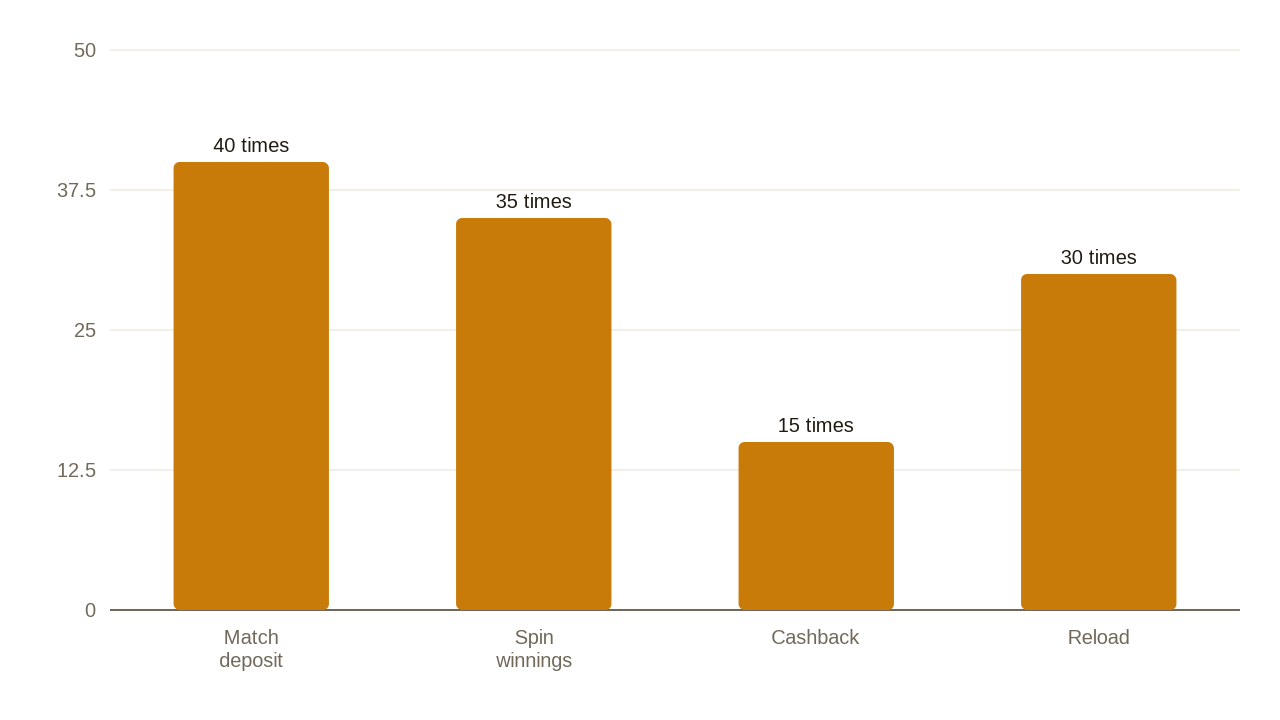
The chart below gives one working figure for each of the four offer families that dominate British casino marketing. Match deposit deals sit at the top of the scale at 40 times. Spin winnings carry 35. VIP reload credit runs near 30, and cashback trails the field at 15. Every bar is a midpoint drawn from operator-published terms across the market and rounded to a clean working number, not a quote of any single promotion.
“Times” reads as a staking instruction. One pound of bonus credit at 40 times must be turned over forty pounds’ worth of bets before it converts to withdrawable cash, and the clock usually runs for a fixed number of days. Nothing in that sentence says the credit will grow. It says what must be wagered, which is the cost side of the trade, and cost is what this page tracks.
The multiplier, converted into pounds
A multiplier only earns its keep once it is converted into pounds. Take the top bar: a £50 deposit matched at 100 percent produces £50 of bonus credit, and 40 times on that credit asks for £2,000 of qualifying stakes. The same credit at 35 times asks £1,750, at 30 times £1,500, and at 15 times £750. Four bars, four very different commitments of time and bankroll.
The spread has a logic to it. A match deal hands out the operator’s money up front, so the strings attached are the heaviest in the market. Spin bundles pay small amounts that only become withdrawable once wagering has run on the winnings, which lands that family at 35. Reload credit rewards existing customers and usually carries around 30. Cashback returns money the player has already lost, so the terms treat it kindly and the multiplier falls to 15.
How to read the four figures
Treat the four figures as expectations rather than rules. Individual deals range from roughly 20 times at the gentle end to 50 times at the punishing end, and a handful sit outside even that band. What the midpoints buy is a sense of scale. When a headline shouts a large number, the chart describes the shape and size of the bill that follows it.
Use the bars in one direction only: from shape to cost. A reader who knows a cashback deal usually lands at 15 times can price it in seconds, because £40 of refunded money at 15 times means £600 of stakes. A reader who sees a match headline can assume the family midpoint of 40 times and adjust later once the full terms have been read.
Why wagering outweighs the return
Return percentages get the headlines and wagering does the damage, because the return is set by the game while the multiplier is set by the deal. A reader can pick high-return titles and still face the same staking bill. That is why this page leads on the multiplier: it is the number the offer itself controls, and the one a comparison can actually move.
The figures were compiled as a model rather than a survey, and they will age as terms move. Midpoints are deliberately wide enough to survive a few quiet edits by a promotions team. Wherever the arithmetic on this page needs a number, the assumption is written out beside the sum, and the worked example later keeps the same discipline.
Wagering norms by offer shape. Model: working midpoints for the main offer families at this end of the market
Match offers: from headline number to staking bill
A match offer is the simplest machine in the market. A reader deposits £20, the site adds 100 percent of it as bonus credit, and the account now holds £20 of real money and £20 of restricted money. The restricted half cannot be withdrawn until a staking target has been met, and at the family midpoint of 40 times that target is £800.
The first question to ask is which base the multiplier applies to. Some sites run it on the bonus alone, which gives £800 in the example above. Others run it on deposit plus bonus, which doubles the base to £40 and the bill to £1,600. The headline never tells you which; only the terms do, and the difference is a full extra thousand pounds of stakes.
The second question is what counts toward the target. Slots usually contribute at 100 percent, so a slots-heavy diet clears a match deal at the advertised pace. Table games and live dealer tables often contribute at 10 percent or less, and some titles are excluded outright. A reader who plans to clear £800 of wagering on a table game at a 10 percent rate is really signing up for £8,000 of play.
A quick worked pair shows the spread. The same £800 target, cleared entirely on slots at 100 percent contribution, means £800 of spins. Cleared on a table game contributing at 10 percent, it means £8,000 of stakes at the same house edge. Nothing about the offer changed between those two sentences; only the game choice did, and the terms price that choice at a factor of ten.
Bet ceilings and sticky credit
The third question is the bet ceiling while wagering is live. Most match terms cap a single stake at £2 to £5, and a breach can void the bonus and every penny won with it. The ceiling is not a courtesy, it is a control: it stretches the play, slows the variance and keeps the staking target running for days rather than hours.
The fourth question is whether the credit is sticky. Plenty of match deals keep the bonus itself out of the cashout: winnings generated by the bonus are paid, the bonus is removed. Others convert the full balance once the target is met. The two shapes can carry identical headlines and produce very different cashouts, which is why the strings matter more than the banner.
Sticky credit is worth a sentence of its own because it changes the arithmetic of a win. If the bonus is removed at cashout, the reader is effectively playing to win the winnings rather than the balance, and a £40 final balance can mean a £20 payout. The model on this page assumes the friendlier conversion, so treat a sticky deal as carrying an extra, unwritten discount.
The assumption on this page, stated plainly, is that match multipliers run on the bonus alone unless a specific deal says otherwise, and that slots carry the wagering. That is the friendliest common reading. Where a deal runs on deposit plus bonus, the bill doubles, and the chart’s midpoint should be read as the floor of the cost rather than the ceiling.
Set against the other families on the chart, the match shape is the most expensive per pound of credit and the most rewarding when it lands. That combination of cost and upside is exactly why it dominates advertising budgets. The rest of this page walks the cheaper shapes before returning to a full worked example of the match maths.
Spin winnings, cashback and reload maths, side by side
Spin bundles look small and cost less than they appear, but the wagering attaches to the winnings rather than the face value. A package of 200 spins at 10p each carries £20 of face value. If the session returns £15 of winnings, the 35 times family midpoint applies to that £15, which is £525 of stakes. The multiplier looks familiar from the match family, but the base is a fraction of the size.
Spin value deserves a second look because it hides inside the headline. Two hundred spins at 5p carry £10 of face value, and the same count at 20p carries £40. Both packages print an identical number of spins. The winnings base differs by a factor of four, and since the multiplier applies to winnings, the eventual wagering bill follows the same ratio.
Two controls decide whether a spin package is worth the walk. The first is the cap on winnings, which commonly sits between £50 and £100 and cuts off the tail of a lucky session. The second is the expiry, usually seven to thirty days, which is short work for a player who spins twice a month. Read both before the headline count means anything.
Cashback and reload credit
Cashback is the cheapest string in the market. The refund usually runs between 5 and 15 percent of net losses, and where the returned balance carries wagering, the chart’s 15 times is the working figure. A reader who loses £50 and earns a 10 percent refund receives £5, and clearing it at 15 times asks £75 of stakes. Some deals skip even that and pay the refund wager-free.
Reload and VIP credit sits between the two. It rewards a second deposit or a tier of loyalty, often at 25 to 50 percent of the amount deposited, and carries a multiplier near the family midpoint of 30. A £50 deposit with a 50 percent reload adds £25 of credit, and 30 times on that credit asks £750 of stakes. It is a match deal in miniature, priced for existing players.
Reload offers also carry their own rhythm in the small print: some run weekly, some monthly, and some attach to loyalty tiers with a cap on how often the credit can be claimed. For a regular player the frequency matters as much as the size, because three modest reloads across a month beat one large one that dictates the deposit pattern.
Line the four families up per pound of credit and the ordering on the chart holds: match at 40 times per bonus pound, spin winnings at 35 per winnings pound, reload at 30, cashback at 15. The base changes with the shape as well as the rate, and the two effects compound in the same direction, which is why the gap between the dearest and cheapest families is so wide in practice.
None of this makes one shape objectively better. A heavy match deal with a big base can beat a light spin package on absolute cashout, and cashback with no wagering at all beats everything on simplicity. The chart is a map of cost per pound, not a verdict, and the sections that follow add the caps, windows and licence questions that turn a map into a decision.
A £20 deposit costed end to end
Here is the full journey of a modest deposit, worked once so the pattern is visible. The reader puts in £20. The site matches at 100 percent and adds £20 of bonus credit. The multiplier on this page’s calculator defaults to 35 times, which sits at the spin-winnings midpoint and the gentler end of match asks, so the staking target is £700.
Why 35 here and 40 on the chart? The calculator needs one number to run, and 35 keeps the example inside the range a cautious reader should plan around. The match family’s own midpoint of 40 would push the target to £800 on the same credit, and deposit-plus-bonus bases push it higher still. Planning at the gentle end and finding worse is a small shock; planning at the top and finding worse is a much bigger bill.
The cap matters as much as the multiplier. This model carries a £500 ceiling on what bonus play can pay out, so a hot streak that runs the balance to £900 still cashes out at £500. Caps are quoted in the small print, they are not negotiable at the cashier, and they apply before the withdrawal request rather than after it.
A note on where the cap sits relative to the target: a £500 ceiling on a £700 staking obligation means the offer is designed to be beaten modestly or not at all, which is the honest shape of most credit deals. Bigger caps exist, usually on bigger deposits, and the ratio between cap and target is a quick test of how much room a deal really gives.
The table on this page collects the journey in one view, with the working stated beside each stage so the arithmetic can be checked line by line.
Stage
Working
Amount
Cash deposited
The sum that triggers the offer
£20
Match credit
100 percent of the deposit
£20
Wagering target
35 times the credit
£700
Cashout ceiling
The cap on bonus-play withdrawals
£500
Days to clear
£700 at £35 staked each day
20 days
At £35 staked each day, the £700 target takes twenty days of play to clear. Stretch the daily stakes and the clock shortens; miss days and the expiry window, covered in the next section, starts to bite. The calculator below runs the same sums on any deposit you care to type, with the same assumptions about the match rate and the multiplier.
Treat the calculator’s output as a budget line rather than a verdict. If £700 of stakes across twenty days sits comfortably inside the entertainment budget, the shape fits. If it feels like pressure, a lighter family, cashback at 15 times or a small spin bundle, is the better fit even with the smaller headline attached to it.
One caution about expectations. A staking target is not a forecast. Most sessions feeding a wagering target end below it, because the games carry a house edge, and the model on this page costs the obligation rather than predicting the outcome. The honest use of the numbers is budgeting: know the stakes before the credit is claimed.
Bonus credit awarded £20.00.
Wagering to clear £1,400.00 at 35 times.
Turnover per pound deposited 70 times.
Assumptions: spin packages return 90 percent of face value before wagering; the session model treats the stated house edge as the expected share of bankroll lost per session.
Minimum deposits, caps, expiry and bet limits
Entry prices in this market cluster tightly. £5 unlocks the smallest spin packages and some bingo-adjacent deals, £10 is the working floor for a proper match offer, and £20 is common where the headline is largest. A low floor is not a discount: the smallest deposits often carry the heaviest multipliers relative to the credit they earn, because the operator is subsidising the headline.
Caps arrive in three places. Winnings from spin bundles are commonly capped between £50 and £100. Match credit carries a cashout ceiling, of which £500 is a typical figure and the one this page’s model uses. Some deals also cap the daily conversion from bonus balance to cash. A cap is never a headline item; it lives in the terms, and it sets the true ceiling on the offer’s value.
Expiry is the quietest cost of all. The usual window runs from seven to thirty days from the moment the credit lands, not from the first spin. Anything uncleared when the clock stops is removed, bonus and winnings alike. A 40 times target on a £20 credit is £800 of stakes, which asks more than £110 a day across a seven day window. Short windows and heavy multipliers rarely mix well.
Bet ceilings deserve a second mention because they interact with expiry. A £2 stake limit on an £800 target means four hundred spins at minimum, spread across whatever days the window allows. Readers who enjoy longer sessions at lower stakes are structurally better suited to that shape than readers who want one evening and a cashout.
Game weighting compounds everything in this section. If table games contribute at 10 percent, a seven day window and an £800 target effectively demand £8,000 of table play, which no careful bankroll survives. The practical rule is simple: read contribution rates, expiry and bet limits as one package, because a deal is only as good as its worst clause.
What the chart shows about these limits
Set against the chart, the pattern is consistent: the families with the heaviest multipliers also carry the shortest patience clauses. Match deals at 40 times are the likeliest to run seven day windows, low bet ceilings and tight conversion caps, while cashback at 15 times often arrives wager-free with no clock at all. Cost and clause travel together.
Order the checks by cost impact: base and multiplier first, since they set the headline sum; contribution rates second, since they set the real pace; cap and expiry third, since they set the ceiling and the deadline; bet limits last, since they set the daily shape. Five minutes with the terms, taken in that order, prices almost any welcome offer in the market.
Where a deal breaks the pattern, it is worth noticing. A £5 floor with a 20 times multiplier and a month to clear is a friendlier shape than its headline suggests. A £20 floor with 50 times and a week is the opposite. The pattern matters more than the size, and the size is what most readers see first.
One habit worth forming: keep a copy of the terms as they appeared when the credit landed. Promotions pages get rewritten, and a reader holding the earlier text has a cleaner position in any later conversation with support. It costs nothing, and it turns the expiry and cap clauses from memory into evidence.
Payment rails and payout windows compared
Getting money out is the part of the offer the advertising never mentions, and the rails decide it. Debit cards, the default rail for most British players, typically settle in 1 to 3 banking days once the cashier approves the request. E-wallets are quicker, with a usual window of 0 to 24 hours after approval. Bank transfer trails at 3 to 5 days and can stretch to 7.
Every window carries the same footnote: approval comes first. The first cashout from a new account almost always waits on identity checks, which can take hours on a well-run site and days on a slow one. The rail’s own speed only starts once the approval is given, so the advertised window and the felt experience are separated by the paperwork.
Prepaid vouchers and some app-based rails are deposit-only, which surprises readers at their first withdrawal. A voucher deposit usually has to pair with a bank or card rail for the return journey, and the slower of the two rails sets the pace. Check the pairing rule before depositing, because it is the one clause that cannot be worked around at the cashier.
British rules ban credit cards as a funding rail on licensed sites, which removes the most expensive way to borrow for play. Offshore cashiers are not bound by that ban, and some still accept credit-funded methods alongside crypto. The licensed rail list is shorter and slower on paper and considerably safer in practice, and the difference is a direct consequence of the licence gap covered in the next section.
Crypto and e-wallet cashiers
Offshore cashiers lean on crypto and e-wallets, and the crypto window can be genuinely fast: minutes on chain once the release is approved. The trade-offs sit around the edges: conversion fees on the way in and out, price movement on the coins themselves, and fewer British rails if a dispute ever needs a chargeback route. Speed is real, and so is the loss of the wrappers British banking provides.
Within the e-wallet family, speed varies less than the marketing suggests: once approved, a wallet-to-bank push is a same-day affair in most cases, and the wallet’s own fees, where they exist, run from free to a small fixed charge. The bigger variable is the cashier’s processing queue, which is why the windows on this page are given as bands rather than single figures.
Rail choice also shapes the entry price in places: some cashiers set lower floors for e-wallets than for cards, and a handful exclude particular e-wallets from bonus eligibility, because bonus abuse tends to follow the fastest rails. Check that the rail you plan to withdraw with is one the offer accepts, and the rest of the journey is bookkeeping.
As a working band for budgeting: e-wallets inside a day, cards within three banking days, transfer up to a week, crypto same-day once approved. The comparison table on this page carries a payout window column on exactly that basis, and the ranges are category-typical rather than promises, because cashier queues move with staffing, verification load and the reader’s own bank.
One more budgeting note: withdrawal minimums exist too. Many cashiers set a £10 to £20 floor on payouts, and a balance below the floor waits until it grows. Small-balance readers should check the payout minimum before claiming a small bonus, because a £15 balance under a £20 payout floor is a trap of the quietest kind.
What a UK licence bundles that an offshore permit does not
A permit from the Gambling Commission is a bundle of protections, and none of them travel with an offshore offer. Every licensed firm sits on a public register, so the entity holding the money can be checked before the first deposit. Licensed sites honour GAMSTOP, so one self-exclusion request covers the whole regulated estate, and complaints route to an approved dispute resolution service when a cashier and a customer disagree. British rules also ban credit cards as a funding rail, require affordability checks on large deposits, and have games tested by approved laboratories before they reach a lobby. An offshore site carries no register entry, no GAMSTOP coverage, no mandated adjudicator, no card ban and no independently audited return figures a British player could check. The protections are the product here. The headline is only the packaging.
How to read the comparison table on this page
The comparison table below puts seven licensed British names beside four offshore ones, and the licence column is the point of the exercise. Every cell is a category-typical band compiled from operator-published terms at the time of writing. A range is not a quote: no cell copies a live promotion, and no cell should be read as an offer currently running anywhere.
The welcome offer column shows the shape and size band a first deposit usually unlocks, from match credit to spin bundles to cashback. The wagering column shows the multiplier band attached to that shape. The minimum deposit column shows where entry usually starts, and the payout window column shows how long a withdrawal typically takes once approved. The final column lists the rails a cashier at this level usually carries.
The British rows are the baseline. Each carries a UKGC licence, which means a public register entry, GAMSTOP coverage, an approved dispute route, the credit card ban, affordability checks and independently tested games. Their terms sit in the same bands as everyone else’s, which is the quiet finding of this whole page: the licence rarely costs much in headline size.
The offshore rows carry the label No UK licence, and that label does the work. It does not say the sites are unsafe; it says the protection bundle set out in the licence section above does not travel with them, and the reader is relying on the operator’s own goodwill and whatever dispute process it volunteers. Bigger headline numbers on those rows are priced against that gap.
Take a single profile as an example of the method, without naming any row: a £10 entry floor, a match band in the low hundreds of pounds, wagering in the 30 to 45 range and a payout window of 1 to 3 banking days. Priced alone, such a deal sits squarely inside the market’s normal shape, and the licence label decides whether the protections travel with it.
Anyone weighing up the best online casinos uk should read the table as a map of norms, then verify any live deal against the operator’s own terms page before depositing, because terms move and no table can chase them in real time. A reader who finds a deal inside the printed bands is looking at a normal offer. One far outside the bands, in either direction, deserves a longer read of the small print.
Brand
Licence
Welcome offer range
Wagering
Min deposit
Payout window
Payment rails
Bet365
UKGC licence
100 percent match to 100 pounds
20 to 35 times
from 10 pounds
1 to 3 banking days
Visa, Mastercard, PayPal, Apple Pay
William Hill
UKGC licence
50 to 100 spins on registration
none on spins winnings
from 10 pounds
0 to 24 hours
Visa, Mastercard, PayPal
Sky Bet
UKGC licence
cashback 5 to 15 percent
1 times on the bonus
from 5 pounds
0 to 24 hours
Visa, Mastercard, Apple Pay
Ladbrokes
UKGC licence
100 percent match to 200 pounds
30 to 45 times
from 10 pounds
1 to 3 banking days
Visa, Mastercard, PayPal, Paysafecard
Paddy Power
UKGC licence
100 pounds plus 25 to 50 spins
30 to 45 times
from 10 pounds
1 to 3 banking days
Visa, Mastercard, PayPal
Coral
UKGC licence
25 to 50 spins on a first deposit
20 to 35 times
from 10 pounds
1 to 3 banking days
Visa, Mastercard, PayPal
Betfred
UKGC licence
up to 100 pounds plus spins
35 to 50 times
from 10 pounds
3 to 5 banking days
Visa, Mastercard, Paysafecard, bank transfer
Mystake
No UK licence
100 percent match to 500 pounds
30 to 45 times
10 to 20 pounds
3 to 5 banking days
Visa, Mastercard, crypto, bank transfer
Goldenbet
No UK licence
150 percent match up to 500 pounds
35 to 50 times
from 20 pounds
up to 7 banking days
Visa, Mastercard, crypto
Rolletto
No UK licence
cashback 5 to 15 percent weekly
20 to 35 times
from 10 pounds
3 to 5 banking days
Visa, Mastercard, crypto, bank transfer
Donbet
No UK licence
100 pounds plus 50 spins
30 to 45 times
from 20 pounds
1 to 3 banking days
Visa, Mastercard, crypto
Cell figures are category-typical ranges put together from operator-published terms at the time of writing. They quote no single promotion. UKGC rows are the British baseline, and none of them are claimable at the offshore offers on this page.
Matching the offer shape to the player
The final question is fit, and fit decides more than any single number. A heavy match deal at 40 times rewards a reader with a settled bankroll, a patient staking plan and a taste for slots, because slots contribute fully and patience converts the target into play rather than pressure. The same deal crushes a reader with two evenings a month and a £30 budget.
Spin bundles fit the small end of the market. The cost is contained, the upside is capped, and the experience is short: a bundle with £20 of face value is an evening’s entertainment with a modest tail. Readers who want a taster of a new site, or who dislike long wagering clocks, get the cleanest deal from this shape, provided the cap on winnings has been read first.
Cashback suits steady players who have already accepted that sessions cost money. A 5 to 15 percent refund with 15 times wagering, or none at all, is the cheapest string in the market, and it pays most to readers who would lose the money regardless. It is a rebate on reality rather than a lottery ticket, and the chart’s low bar reflects that honesty.
Reload credit belongs to regulars. A reader depositing weekly anyway gains a 25 to 50 percent top-up on planned spend, and 30 times on the credit is a fair price for it. The trap is spending to earn it: a reload that induces a deposit that would not otherwise have happened is not a rebate, it is a purchase.
Licence and budget come last
Licence is the last axis, and the one with the longest consequences. The British rows of the comparison table carry the full protection bundle; the offshore rows carry bigger headlines and none of the bundle. A reader who values GAMSTOP, dispute routes and tested games should add that value into the comparison, because the offshore headlines do not include it. A reader who does not has already made that choice, whatever any page says.
Set the budget before the shape, and the shape picks itself. A reader with £20 a month and no appetite for long clocks belongs with cashback and small bundles. A reader with time, patience and a slots habit can take the 40 times headline and clear it comfortably. Neither choice is wrong; only the mismatch between budget and strings is, and the mismatch is visible in advance on this page.
One warning belongs at the end of any costing exercise. The numbers move, the promotions move faster, and no model survives a season unchanged, which is why every figure on this page carries its assumption in the open. A reader who repeats the arithmetic on the day of the deposit will always be more current than any guide, including this one.
Anyone comparing the best online casinos uk is, underneath the branding, comparing staking bills. The whole-market view, compressed: match deals cost the most per pound and pay the most; spin bundles cost the least attention; cashback costs the least in strings; reload rewards loyalty that already exists; and the licence decides what happens when something goes wrong. Price the strings, check the operator’s own terms, and claim with the bill in view rather than behind it.
Is it legal for a player in Britain to use an offshore casino?
Yes. British law does not make it an offence for an adult to play at a site licensed overseas, and such sites serve British players openly. The legal exposure sits with the operator, which runs outside the UK Gambling Commission regime, not with the player. What changes is protection rather than permission, because a site without a UK licence sits outside the British register, GAMSTOP and approved dispute resolution.
What does 35 times wagering actually cost?
Multiply the bonus credit by the multiplier. A £20 credit at 35 times means £700 of qualifying stakes before the balance turns into withdrawable cash. If table games count only 10 percent toward the target, clearing on those games means staking £7,000 in practice, so game choice moves the bill as much as the headline does. The calculator on this page runs the same arithmetic at any deposit size.
Which payment rail pays out fastest?
E-wallets are usually the quickest, with a typical window of 0 to 24 hours once the cashier approves the request. Debit cards land in 1 to 3 banking days, bank transfer can stretch to 5 or 7, and crypto settles in minutes on chain after approval. Every window assumes verification is already complete, because identity checks sit outside the rail's own timing.
How long do I get to clear a welcome offer?
Seven to 30 days is the common band, and the clock usually starts when the credit lands rather than at the first spin. Anything uncleared at expiry, bonus and winnings alike, is normally removed. Short windows pair badly with heavy multipliers: a 40 times target on a £20 credit is £800 of stakes, which asks more than £110 a day across a seven day window.
Who suits a heavy match offer?
Match deals near 40 times suit players with a settled bankroll, a patient staking plan and a slots-heavy diet, because slots usually contribute fully to the target. They fit badly with small budgets, short sessions or table-game play, where contribution rates stall progress. Steady low-stakes players usually get more from cashback or modest spin bundles, where the strings are lighter and the ceiling lower.
What does the licensed alternative give me?
The British market carries welcome deals of similar sizes, and each comes with the bundle a UK permit provides: a public register entry, GAMSTOP coverage, an approved dispute route, the credit card ban, affordability checks and independently tested games. The wagering midpoints run close to the offshore ones, so the licence usually costs little in headline terms and a great deal in protection.
How were the numbers on this page built?
They are modelled midpoints rather than quotes. Published terms from across the market were grouped by offer shape and reduced to one working figure per family: 40 times for match deals, 35 for spin winnings, 15 for cashback and 30 for reload credit. The worked example and the calculator share those assumptions, and every figure carries its assumption beside it so the arithmetic can be checked.
Do I pay tax on casino winnings in Britain?
No. Gambling winnings are free of tax for players in the UK whatever the size of the win and whatever the source, licensed or offshore. The burden falls on operators, who pay duty on their takings. Losses cannot be offset against other income, and no return needs declaring for casino play itself, though a reader with unusual circumstances can confirm the position with an accountant.
What an offshore licence does not carry
These offers run outside the UK Gambling Commission regime. The public register, the national self-exclusion scheme, approved dispute resolution, the credit card ban and independently tested games all belong to the licensed market, and none of them follow an offer offshore. A disagreement with an offshore operator is settled with that operator under its own terms. If self-exclusion matters to you, GAMSTOP covers licensed operators only, and nothing on this page works around that.
Gambling can harm. The National Gambling Helpline is free, confidential and open around the clock on 0808 8020 133, and BeGambleAware publishes self-help tools.