Night Luck
8.2/10Casino welcome bonus 805% up to €6,400 + 280 FS
- MuchBetter · VISA · Apple Pay
- Crypto welcome 140% up to 1,600 USDT
- VIP pack 800% up to €14,500
Terms move often. Verify on the operator's own page.
Prizes costed, terms shown
18+. Wagering is risky. Only ever stake what you can afford to lose.
Match £10 at 100 per cent and the wagering bill lands at £350 behind a £200 ceiling, while the rail paired for the exit decides whether winnings arrive in about an hour or in 72 hours. This page prices both halves of that trade: the instant deposit and the paired way out.
The comparison board arranges the market's offers in editorial columns so the shape of each is visible at a glance. Terms move often at this end of the market, so treat the display as a snapshot and verify the live wording on the operator's own site before you fund an account.
Casino welcome bonus 805% up to €6,400 + 280 FS
Terms move often. Verify on the operator's own page.
Welcome bonus €/£5,000 + 500 FS
Terms move often. Verify on the operator's own page.
Welcome pack €5,000 + 500 FS + €650 free bet
Terms move often. Verify on the operator's own page.
Welcome package 300% up to €/£1,000 + 150 FS
Terms move often. Verify on the operator's own page.
On this page
Apple Pay sits in a casino cashier as a front for a debit card. You tap, Face ID or your passcode confirms, and the wallet passes a token rather than your actual card number to the cashier. The charge lands on the debit card registered in your Wallet app within seconds, and the balance updates before you have left the deposit screen.
Speed is the rail’s whole commercial argument at this end of the market. Typing a long card number into a cashier on a phone is slow and error prone, while a wallet charge removes the typing, removes the card from the screen, and leaves a single confirmation between you and the funds. For a £10 deposit, the size this page models, the saving is measured in seconds rather than minutes, and it repeats on every top-up.
The token detail matters for privacy and for records. Because the merchant never sees the raw card number, a cashier holds a device-specific stand-in instead of your actual details, and the itemised trail lives on the card statement rather than in the wallet. What the wallet does not change is the economics: the debit card behind it is the rail that carries the money, the issuer that can approve or decline the charge, and the account any reversal would return to.
One consequence follows for bonuses. An offer’s terms care about the funding method they name, and a wallet deposit is usually read as a card deposit, because that is what it is underneath. Exclusions aimed at e-wallets rarely touch a wallet charge, though the wording of each offer decides. The practical read is simple: the wallet rarely costs you a bonus, but reading the funding clause costs nothing either.
The prerequisites are narrow, which is why the rail feels effortless once it works. You need an Apple device, an Apple ID signed into it, and a debit card added to the Wallet app. On an iPhone the flow runs through Face ID or your passcode; on an iPad the same buttons appear in Safari; on a Mac the machine asks for a confirmation through a paired iPhone or an Apple Watch. A phone running Android cannot join in, because the wallet belongs to Apple and the nearest equivalent lives under a different name.
Region settings do quiet work here. The Wallet app ties a card to a region, and a cashier reads that region from the transaction, so a card registered abroad can pass the wallet check and still fail the cashier’s own country screen. If a deposit declines with no obvious cause, the mismatch between the card’s region and the account’s country is a common culprit, along with an issuing bank that blocks gambling charges by default.
Before you register anywhere, run a three-line check. First, confirm the cashier actually lists Apple Pay among its deposit methods, because acceptance here is patchier than card acceptance. Second, confirm which card sits behind the wallet and whether that issuer allows gambling charges. Third, open the cashier’s withdrawal page and find where a payout would travel, because the answer is almost never back through the wallet itself. The third line matters most: the deposit rail and the exit rail are different animals on this subject, and the rest of this page prices the gap between them.
None of the checklist costs money, and all three lines take less time than the deposit they protect.
Here is the asymmetry that shapes this page. The deposit leg is a tap; the withdrawal leg is a routing decision the cashier makes on your behalf. Most cashiers at this end of the market treat the wallet as a deposit-only method, which means money you win cannot come back through it. The payout has to travel by a paired rail: the debit card behind the wallet, a bank account in your name, or an e-wallet you have verified with the cashier.
The plumbing explains why. A wallet charge is a card authorisation, quick to take and quick to reverse. A payout belongs to a different transaction family with its own rules, and card schemes plus anti-money-laundering practice steer cashouts toward the original funding source or a verified bank account. Some operators pay back to the underlying card where the scheme allows it, but many simply list the wallet in the deposit column and leave the withdrawal column to cards and banks.
That asymmetry produces a rule worth writing down: check the exit before the entrance. A cashier that takes your £10 in one tap may route winnings to a debit card that needs a banking day or three, or to a bank transfer that needs longer still. Neither outcome is a scandal, and both are slower than the deposit felt. The honest comparison is not wallet against card but wallet-in against whatever the cashier pairs for the way out, and the pairing is where the hours live.
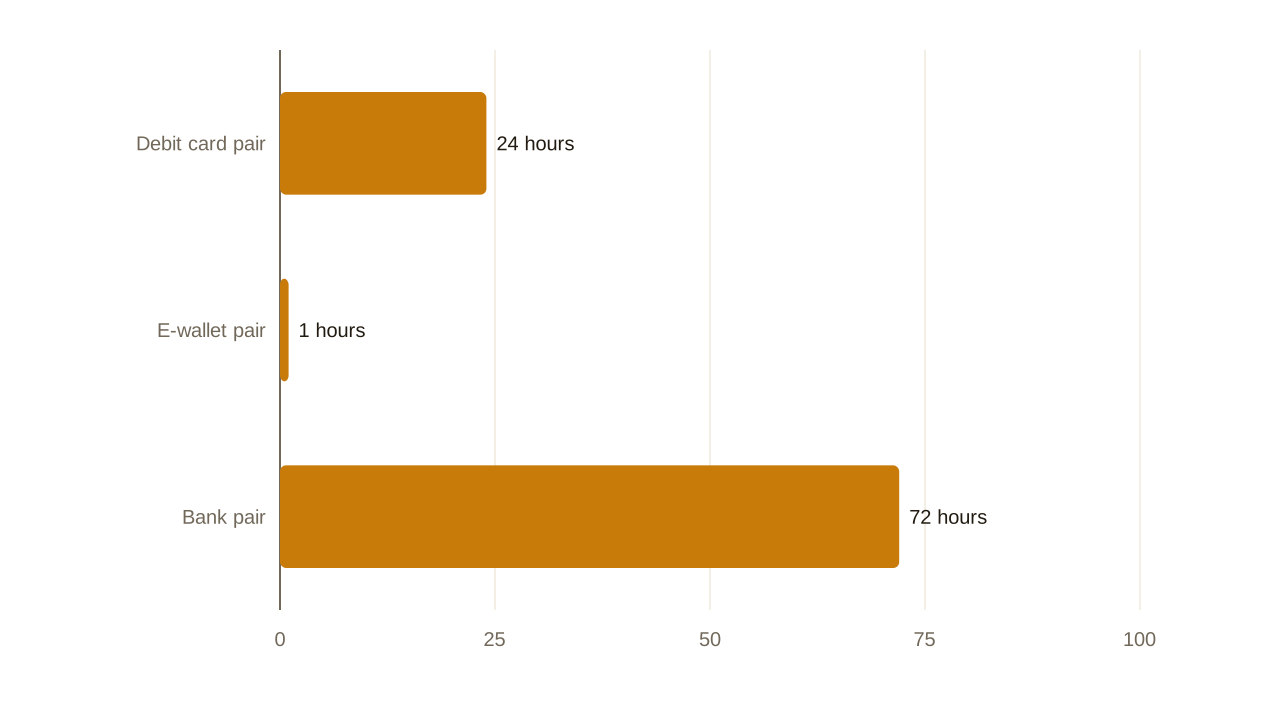
The chart below turns that pairing into numbers, and the exit you choose is the single biggest lever on how long your own cashout takes.
The chart on this page models three exit pairings and puts a window on each. Pair the wallet with a verified e-wallet and the model puts the return leg at around an hour, the quickest exit in the set. Pair it with the debit card behind the wallet and the model stretches to 24 hours, a day’s wait for the same money. Pair it with a bank transfer and the model runs to 72 hours, a full long weekend from request to cleared funds.
Three assumptions sit under those bars. First, the clock starts when the cashier approves the payout, not when you tap the button, and approval is where slow operators hide their delay. Second, the windows are model bands for this market, not promises attached to any cashier, and an operator’s own published window always outranks a model. Third, the quickest band assumes the e-wallet is already verified, because identity checks can freeze any rail, however fast it looks on paper.
Read the spread rather than the bars. The distance between the quickest and slowest pairings is measured in days on the same withdrawal, a wider gap than any fee or deposit floor on this page. A £10 cashout is worth the same amount on every rail; the question is when you can spend it. That is why the exit pairing, not the deposit tap, is the decision this page keeps returning to.
One habit follows from the model. Where a cashier lets you register an e-wallet for payouts alongside the wallet for deposits, that combination captures the quickest band, and it costs nothing to set up in advance.
Bonus credit awarded £10.00.
Wagering to clear £700.00 at 35 times.
Turnover per pound deposited 70 times.
Assumptions: spin packages return 90 percent of face value before wagering; the session model treats the stated house edge as the expected share of bankroll lost per session.
Gambling online is legal in Britain for adults through operators holding a Gambling Commission licence, and Apple Pay is simply a payment method inside that framework. Sites without a UK licence sit outside the scheme, whatever rails their cashiers accept. The wallet changes none of the law; the licence behind the cashier decides everything, so check the register before you fund an account.
Wagering counts the stakes you place, not the money you lose. On this page's model, a £10 bonus at 35 times carries a £350 turnover bill, and every qualifying spin contributes whether it wins or loses. The rule attaches to the bonus credit rather than your own deposit, and the cashier's terms publish the multiplier before you commit anything.
Many cashiers list the wallet as a deposit-only method, so payouts route elsewhere: the debit card behind the wallet, a verified bank account, or an e-wallet the cashier recognises. Card scheme rules and anti-money-laundering practice steer withdrawals toward the original funding source. Read the withdrawal page before depositing, because the paired exit, not the wallet, sets how long your money takes to arrive.
The rail does not change an offer's gates. A ceiling such as the £200 figure in this page's model caps what the bonus can pay out, and a time window usually applies to clearing the wagering before the credit expires. Both numbers sit in the offer's terms on the cashier's own page, so read them before the deposit rather than after.
The rail suits iPhone owners who make small, regular deposits and value speed and privacy above all, since the tap takes seconds and the card number stays hidden. It suits less well if you plan larger transactions, if you play on Android devices, or if fast withdrawals top your list and the cashier's only exit is a slow pairing.
A licensed cashier keeps you inside the protections that make British gambling workable: a public register to check, GAMSTOP self-exclusion across licensed sites, an approved dispute route, affordability checks and the credit card ban. An offshore cashier offers none of those, even when it lists the same wallet. The payment method is identical; the protections standing behind it are not.
You need an Apple device, an Apple ID signed in, and a debit card added to the Wallet app, with Face ID or a passcode enabled. Deposits run through apps and through Safari on iPhone, iPad and Mac. Android phones cannot use the wallet at all, so players on those devices need a different method entirely.
The wallet itself charges nothing for a transaction, and cashiers in this market rarely surcharge wallet deposits. Costs can still appear one layer down: the card behind the wallet sets its own terms, and a currency conversion would add a margin. For a British deposit in pounds the fee line normally reads zero, and the cashier's published terms confirm it.
These offers run outside the UK Gambling Commission regime. The public register, the national self-exclusion scheme, approved dispute resolution, the credit card ban and independently tested games all belong to the licensed market, and none of them follow an offer offshore. A disagreement with an offshore operator is settled with that operator under its own terms. If self-exclusion matters to you, GAMSTOP covers licensed operators only, and nothing on this page works around that.
Gambling can harm. The National Gambling Helpline is free, confidential and open around the clock on 0808 8020 133, and BeGambleAware publishes self-help tools.
Keep reading
Daily Prize Games. Independent costing of casino offers for British readers. No operator pays for a word on this page; board placement is paid for and explained on the How We Are Paid page. 2026.