Night Luck
8.2/10Casino welcome bonus 805% up to €6,400 + 280 FS
- MuchBetter · VISA · Apple Pay
- Crypto welcome 140% up to 1,600 USDT
- VIP pack 800% up to €14,500
Terms move often. Verify on the operator's own page.
Prizes costed, terms shown
18+. Wagering is risky. Only ever stake what you can afford to lose.
Phone-billed deposits top out near £10 a day on the standard tier, and no payout ever travels back down that rail: the exit has to follow by bank transfer or debit card. This page costs the whole trade, from the ceilings and the fees to the session maths a £20 bankroll demands at £0.50 a spin.
The board on this page is an editorial comparison, put together by hand and kept under review rather than read off any cashier. Terms of this kind move often, so treat its entries as pointers and verify the terms on the operator's own page before you commit a penny.
Casino welcome bonus 805% up to €6,400 + 280 FS
Terms move often. Verify on the operator's own page.
Welcome bonus €/£5,000 + 500 FS
Terms move often. Verify on the operator's own page.
Welcome pack €5,000 + 500 FS + €650 free bet
Terms move often. Verify on the operator's own page.
Welcome package 300% up to €/£1,000 + 150 FS
Terms move often. Verify on the operator's own page.
A pay by phone casino moves money through your mobile account instead of your bank card. You pick the phone option in the cashier, enter the number attached to the account, and confirm the charge with a code sent by text. The amount then appears on the next monthly bill, or comes straight off the prepaid balance if the number runs on pay as you go. No card number passes through the cashier, and the operator never sees your banking details at all.
A third-party biller sits in the middle of that transaction. The biller talks to the network on one side and to the casino on the other, and it is the biller’s limits, not the casino’s, that usually set how much you can charge in a day. That middle layer is also why the rail only runs one way: a biller can add a charge to a phone account, but it cannot take money off it and hand it back to you.
The direction matters more than it first appears. A deposit by phone is quick because nothing needs verifying at the point of payment: the network already knows who you are. A payout is the opposite, because money leaving a casino has to arrive somewhere that can hold it. Only a bank account or a card can do that, which is why every carrier-billing cashier asks you to register a receiving rail before your first withdrawal, and why the verification checks that rail rather than the number you deposited from.
Read the flow as two separate pipes. The inbound pipe is instant, capped and anonymous to the cashier. The outbound pipe is slower, verified and owned by your bank. Planning for both is the whole skill of using this rail well.
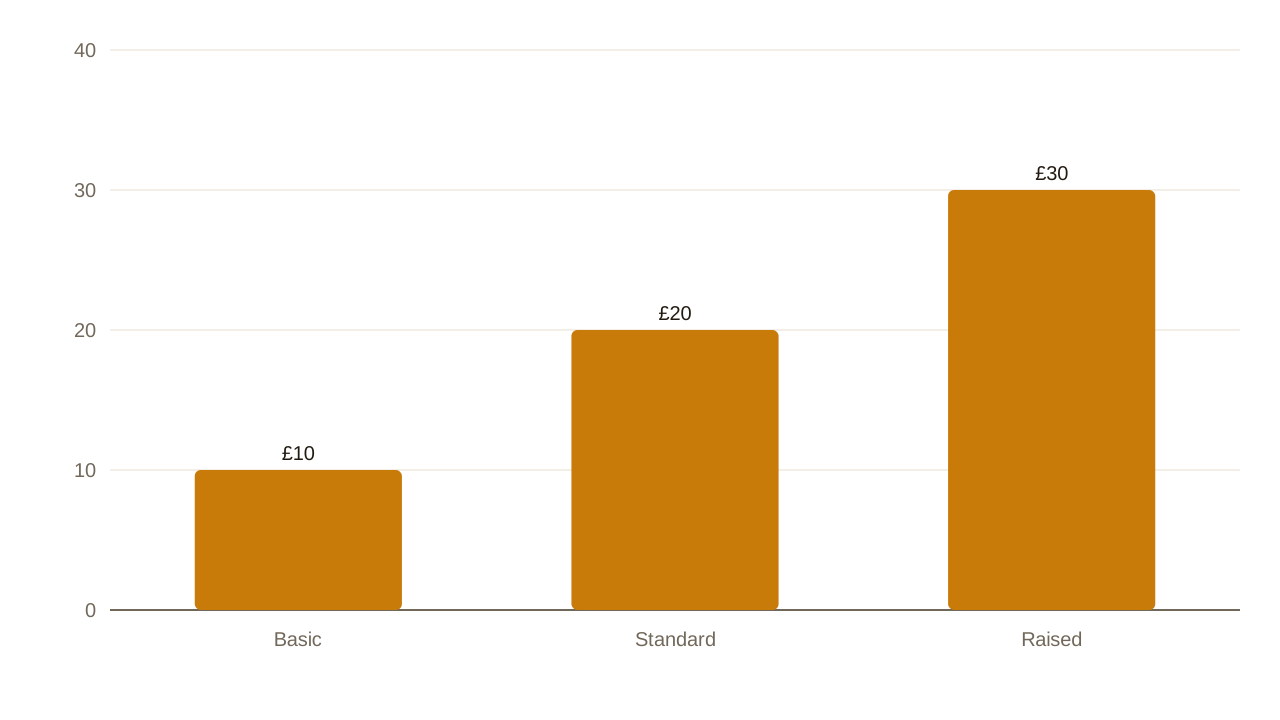
Carrier billing runs under a daily ceiling, and the standard tier for UK mobile accounts sits at about £10 a day. Some billers raise the cap to £20 for verified accounts, and a few go to £30 on request, but the ten pound line is the one most readers will actually meet. The chart below shows the three tiers side by side.
That ceiling quietly reshapes every plan you make. A £20 bankroll does not fit through a £10 door in one go: it takes two deposits on two days, or one deposit on a raised tier. A welcome package that asks for £20 in a single transaction is simply out of reach on the basic tier, no matter how much you would like to claim it. Even the pacing changes: with £10 arriving per day, a losing session ends the day’s play by default, and the brake is built into the rail rather than chosen at the cashier.
Treat the ceiling as both a cost and a feature. As a cost, it splits bankrolls across days and can push you onto a raised tier with its own checks. As a feature, it enforces the kind of daily limit that licensed operators ask you to set anyway. Few payment rails carry a spending brake this firm, and none of it depends on willpower late at night.
Where the tiers differ, the differences compound. A raised limit usually follows extra checks at the biller or the network, and some operators treat the tiers differently in their payment terms. Before you plan anything on this rail, find the ceiling on your own account, because every number on this page assumes the standard £10 tier unless it says otherwise.
Expected loss per session £0.70.
Expected loss across 6 sessions: £4.20.
Assumptions: spin packages return 90 percent of face value before wagering; the session model treats the stated house edge as the expected share of bankroll lost per session.
The payment method itself is legal, and British customers can use it. What decides whether a casino may lawfully serve you is its licence. An operator holding a UK Gambling Commission licence may offer carrier billing under UK rules, while an offshore site has no such licence, which means the public register, dispute routes and the exclusion scheme do not reach it. Check the licence before the cashier.
Yes, once a bonus attaches. Wagering is a property of the offer, not of the rail, so a match claimed through a phone-billed deposit carries the same multiplier as one claimed on a card, commonly 20 to 50 times the bonus funds. What changes is eligibility: some packages exclude carrier billing or set a higher minimum deposit for it, so read the payment terms before planning the claim.
No. Carrier billing runs in one direction only, so every payout must follow a rail that can receive money, usually a bank transfer to a verified account or a withdrawal to a registered debit card. That second rail needs its own verification, and the payout window depends on it rather than on the phone. Register the receiving method before your first deposit rather than after it.
The standard tier caps carrier-billed deposits at about £10 a day, with some billers raising the limit to £20 for verified accounts and a few reaching £30. The ceiling is set by the biller and the network rather than by the casino, and the cap may be shared across casinos rather than applied per site. Check the limit on your own account before planning a bankroll around it.
The rail suits low-stakes players who want a spending brake built into the payment itself: small deposits, a daily ceiling, and no card details stored anywhere. It suits anyone who prefers not to attach a card at all. It fits poorly for large match offers, fast cashouts, or anyone who wants deposits and withdrawals on a single method, because the rail cannot pay out.
A debit card or a regulated e-wallet at a UK Gambling Commission licensed casino. Both rails run in both directions, so the deposit and the payout travel one method, and the licence brings the public register, GAMSTOP, approved dispute resolution and enforced deposit limits. The credit card ban still applies, so the card in question is a debit card. Verification is simpler when one rail handles everything.
Some do. A biller may add a handling charge to each transaction, and some operators levy their own fee on small deposits, so the price of a deposit is not always its face value. Any charge should appear on the cashier screen before you confirm it. At the standard ceiling the sums are unforgiving, because a flat fee is a larger share of a £10 deposit than of a £30 one.
Most likely the terms exclude carrier billing, or the deposit fell below the minimum the offer accepts. Some packages treat phone-billed deposits as ineligible for the match, and others accept them only on a raised tier or at a reduced rate. That rule is rarely stated in the headline: look for it among the payment methods listed in the terms, and confirm it before funding the deposit.
These offers run outside the UK Gambling Commission regime. The public register, the national self-exclusion scheme, approved dispute resolution, the credit card ban and independently tested games all belong to the licensed market, and none of them follow an offer offshore. A disagreement with an offshore operator is settled with that operator under its own terms. If self-exclusion matters to you, GAMSTOP covers licensed operators only, and nothing on this page works around that.
Gambling can harm. The National Gambling Helpline is free, confidential and open around the clock on 0808 8020 133, and BeGambleAware publishes self-help tools.
Keep reading
Daily Prize Games. Independent costing of casino offers for British readers. No operator pays for a word on this page; board placement is paid for and explained on the How We Are Paid page. 2026.