Night Luck
8.2/10Casino welcome bonus 805% up to €6,400 + 280 FS
- MuchBetter · VISA · Apple Pay
- Crypto welcome 140% up to 1,600 USDT
- VIP pack 800% up to €14,500
Terms move often. Verify on the operator's own page.
Prizes costed, terms shown
18+. Wagering is risky. Only ever stake what you can afford to lose.
Forty roulette rounds on a £5 stake turns over £200 an hour, and a 2.5 per cent edge prices that seat at about £5 before a single side bet. This page costs live tables from the 50p budget rooms to the £25 VIP floors, then shows what game pace and stake controls do to the hourly bill.
The board on this page is an editorial comparison of offers, assembled so the key numbers sit in one place. Terms move often in this market, so treat every line as a snapshot and verify the current detail on the operator's own page before you deposit.
Casino welcome bonus 805% up to €6,400 + 280 FS
Terms move often. Verify on the operator's own page.
Welcome bonus €/£5,000 + 500 FS
Terms move often. Verify on the operator's own page.
Welcome pack €5,000 + 500 FS + €650 free bet
Terms move often. Verify on the operator's own page.
Welcome package 300% up to €/£1,000 + 150 FS
Terms move often. Verify on the operator's own page.
Live tables charge for time in a way slots never do. A spin on a reel is a decision you make, while a live round arrives whether you act quickly or not, and the dealer sets the rhythm. That makes the honest price of a live seat an hourly figure rather than a per-spin one, and it is worth working out before you choose a room.
The arithmetic takes three inputs and multiplies them. The first is your stake per round. The second is the pace of the game, counted in rounds per hour. The third is the house edge on the bets you actually place. Multiply the stake by the rounds, then by the edge, and the result is the expected cost of one hour at that table.
Take a common seat: £5 a round on live roulette at a table turning about forty rounds an hour. Turnover reaches £200 across the hour. Hold the edge at 2.5 per cent, a working figure for a single-zero wheel with a couple of outside bets in the mix, and the expected cost lands near £5. Change the game and the same stake moves the number: a blackjack table dealing eighty hands an hour doubles the turnover at the same edge, while a slow game show wheel running thirty rounds cuts it by a quarter.
Three levers sit in your hands. The stake is the obvious one, and halving it halves the bill. Game choice is next, because pace varies by more than half between the quickest and slowest live formats. Side bets are the quiet one: they carry steeper edges than the parent game and tempt at exactly the moments you want more action.
One caution belongs up front. The per-hour cost is an expectation, the shape the mathematics settles toward across thousands of rounds. A single hour can land far from it in either direction, which is why the stake you choose matters more than the edge you accept: the stake decides how fast the swings arrive and how large they are when they do.
Why build a page around the hourly figure at all, when the market advertises welcome packages instead? Because the package is a one-off and the table is a habit. A matched deposit is priced once, at claim, and its wagering can be costed in an afternoon. The live seat is priced every hour you sit in it, and the sum across a month of evenings is usually the larger number by a distance. Pricing the seat first, and the package second, is the order that keeps the totals honest.
This page works through each lever in turn. It prices the room classes by their table minimums, from the 50p budget lobbies to the £25 VIP floors. It counts the pace of the main live games and shows what that does to hourly turnover. It walks a worked hour at a £5 stake, then sets out the stake controls that keep a session inside its budget, and closes with the licence gap and the comparison reading that turns those numbers into a choice. The habit behind all of it is small: know the stake, know the pace, know the edge, and multiply. Everything else in the live lobby, from the studio lighting to the host’s patter, is decoration around that one line of arithmetic, and a reader who leaves with the multiplication settled can price any table on any site before the first chip is placed.
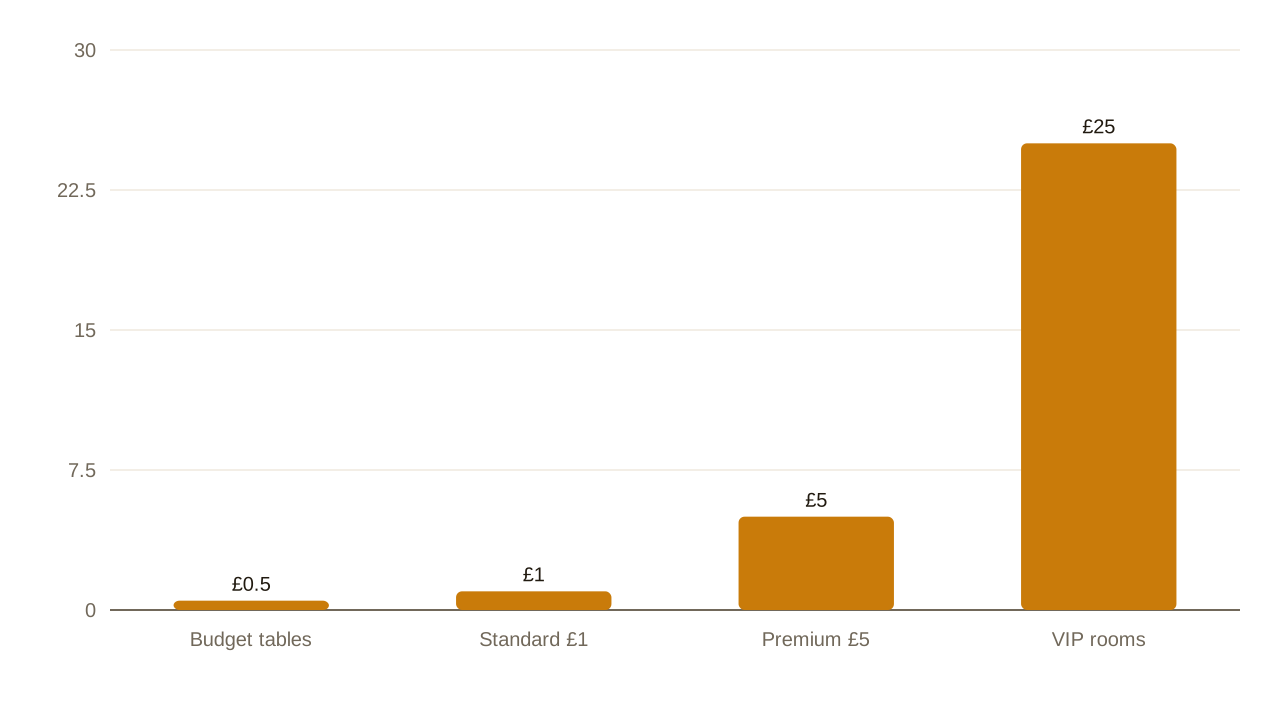
Every live lobby sorts its tables into bands, and the band names vary but the structure rarely does. At the cheap end sit budget tables with minimums around 50p, built for long sessions and small floats. Next come the standard rooms at £1, which is where a large share of British live play happens. Above them, premium tables ask £5 a round, and at the top, VIP rooms start at £25 and climb, often behind a request to the operator’s host team.
The chart below plots the four room classes by their typical minimums, from 50p to £25. Read it as a map of where the hourly bill doubles: each step up the ladder multiplies the price of the same hour at the same pace, because the minimum sets the floor under every round you play.
A table minimum is a per-bet floor, not an hourly fee. Sit at a 50p table and one chip a round turns over £20 across forty rounds, with an expected cost of about 50p at the working edge. The £1 room doubles that to £40 and £1. The premium £5 seat turns over £200 and expects to cost £5. The VIP minimum of £25 turns over £1,000 an hour on the same pace, which is why that band is priced for floats in the thousands rather than the hundreds.
Minimums also differ inside a single table. Roulette layouts often carry a higher floor for inside numbers than for outside bets, and side bets on card games commonly set their own minimums, sometimes above the main game’s. The limits panel on each table prints the full set, and it is worth reading before the first chip goes down, because the cheapest seat in the room is only as cheap as the cheapest bet it allows.
The gap between the minimum and the maximum also shapes how a table plays. A £1 to £5,000 range invites cautious players and chasers to the same felt, and the pace of decisions around you will reflect the mix. A narrow range, a minimum to ten times the minimum, tells you the room is built for one kind of bankroll and paces itself accordingly. Neither shape is better; they are different machines, and the bill differs with them.
Choosing a class is really choosing a burn rate. A 50p or £1 table turns money over slowly enough that conversation, betting windows and the odd missed round genuinely slow the bill. A £5 table asks for a decision every round and prices hesitation at the same rate as action. A £25 room is built for players whose evening budget runs to hundreds, and sitting there with a £150 float means a short night on any ordinary run of cards or spins.
Two practical checks follow from the ladder. First, match the class to the float: on the model in this guide, a £150 bankroll across six sessions fits the £1 and £5 bands, with the budget tables as the conservative choice and the VIP rooms out of range. Second, find the right band inside the lobby before you fund anything: most live lobbies carry a low-stakes filter that surfaces the 50p and £1 rooms, the premium seats sit one tab along, and the VIP rooms rarely appear beside them at all, hidden behind their own menu or behind an invitation once play reaches a level the operator sets.
Expected loss per session £3.75.
Expected loss across 6 sessions: £22.50.
Assumptions: spin packages return 90 percent of face value before wagering; the session model treats the stated house edge as the expected share of bankroll lost per session.
Yes, when the site holds a UK Gambling Commission licence, which makes the offer lawful for British players and subject to British rules. Some live tables run offshore without that licence. They are not licensed for Britain, so they sit outside the public register, GAMSTOP and approved dispute resolution, and the protections a licensed site carries simply do not apply there.
A live dealer bonus is credit that must be turned over a set number of times before it converts to withdrawable funds, with 30 to 50 times a common band at this end of the market. Live tables often contribute only a fraction of a stake toward that total, and some offers exclude them entirely, so read the contribution table in the offer's own terms before planning live play around a bonus.
Licensed lobbies centre their cashiers on debit cards, with PayPal, Apple Pay and bank transfer widely available, and withdrawals returned to the rail that funded them. Offshore cashiers lean toward e-wallets and crypto, with payout windows typically running one to seven banking days against the hours-to-days range common under a UK licence. Check the rails before depositing, because money usually has to leave by the route it arrived.
Most do. Welcome packages commonly cap what a bonus converts to, cap the stake that counts while wagering is active, and set an expiry window of a few days to a month for clearing. Miss the window and the remaining credit, with any winnings tied to it, is usually forfeit. The cap and the deadline sit in the offer's own terms, so price both before you claim.
On this page's model, the expected hourly cost is the stake multiplied by the rounds per hour multiplied by the house edge. A £5 stake at a forty-round roulette table with a 2.5 per cent working edge costs about £5 an hour. Faster blackjack doubles the figure at the same stake, and a slower game show wheel cuts it. The stake is the input you control, and it moves the price directly.
Live tables suit players who want paced, watchable games where each round is a separate decision and the stake can be held steady. They ask for a float that supports the table minimum across a session, so the £1 and £5 bands fit moderate bankrolls best. Players who prefer fixed evening costs, or who run very small floats, usually do better at budget tables or in bingo rooms.
UK-licensed lobbies run the same room structure, from £1 standard tables through premium seats, under a Gambling Commission licence. That brings the public register, GAMSTOP self-exclusion, approved dispute resolution, the credit card ban and fairness testing, along with debit-card cashiers and payout windows measured in hours to days. The headline offers are smaller than offshore packages typically claim, but every term behind them is enforceable.
Typical minimums run from 50p at budget tables through £1 standard rooms and £5 premium seats to £25 and above in VIP rooms. Maximums sit alongside them on the limits panel and vary widely by room. Inside bets on roulette and side bets on card games often carry higher minimums than the main game, so read the full set on the panel before the first round.
These offers run outside the UK Gambling Commission regime. The public register, the national self-exclusion scheme, approved dispute resolution, the credit card ban and independently tested games all belong to the licensed market, and none of them follow an offer offshore. A disagreement with an offshore operator is settled with that operator under its own terms. If self-exclusion matters to you, GAMSTOP covers licensed operators only, and nothing on this page works around that.
Gambling can harm. The National Gambling Helpline is free, confidential and open around the clock on 0808 8020 133, and BeGambleAware publishes self-help tools.
Keep reading
Daily Prize Games. Independent costing of casino offers for British readers. No operator pays for a word on this page; board placement is paid for and explained on the How We Are Paid page. 2026.