Night Luck
8.2/10Casino welcome bonus 805% up to €6,400 + 280 FS
- MuchBetter · VISA · Apple Pay
- Crypto welcome 140% up to 1,600 USDT
- VIP pack 800% up to €14,500
Terms move often. Verify on the operator's own page.
Prizes costed, terms shown
18+. Wagering is risky. Only ever stake what you can afford to lose.
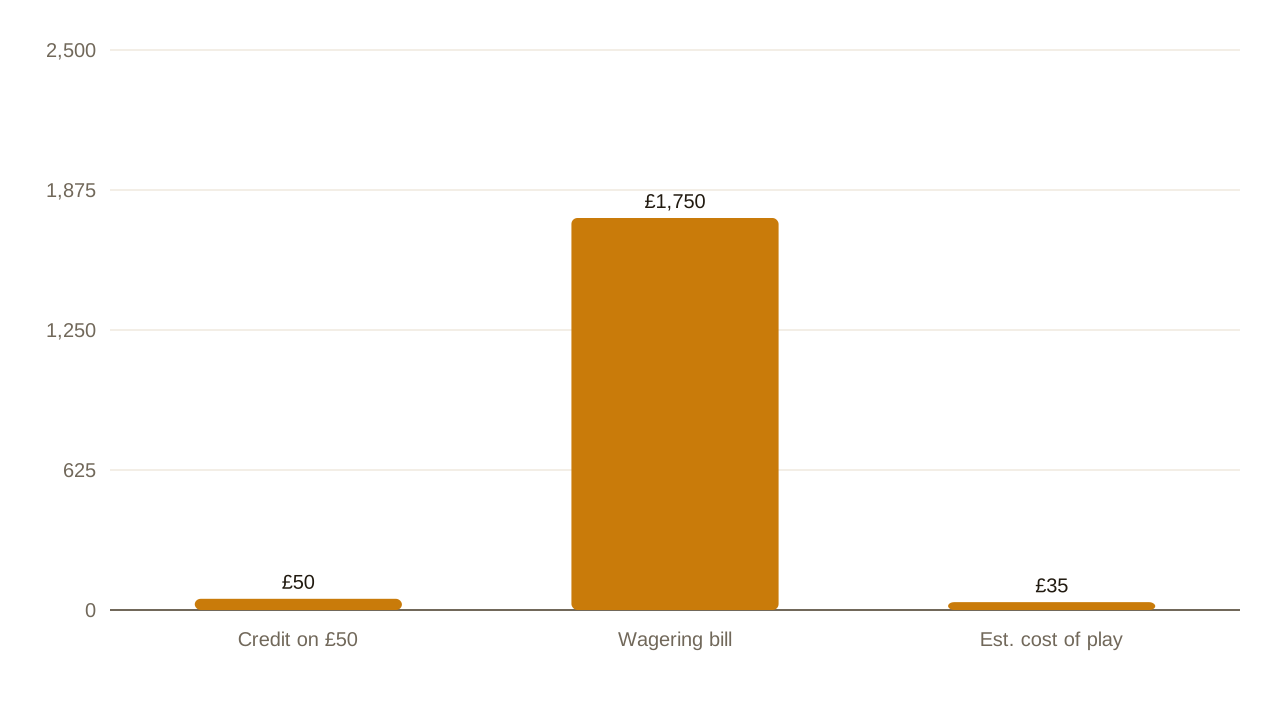
A slots sign up bonus of £50 matched at 100 percent reads as £100 of play on the door, yet the model behind this page prices the clearing bill at £1,750 of turnover and about £35 of expected cost, which leaves roughly £15 of genuine value.
The board on this page is an editorial comparison of current offers compiled by the Daily Prize Games team. Terms move often and without notice, so verify any line you intend to act on against the operator's own terms page before money moves.
Casino welcome bonus 805% up to €6,400 + 280 FS
Terms move often. Verify on the operator's own page.
Welcome bonus €/£5,000 + 500 FS
Terms move often. Verify on the operator's own page.
Welcome pack €5,000 + 500 FS + €650 free bet
Terms move often. Verify on the operator's own page.
Welcome package 300% up to €/£1,000 + 150 FS
Terms move often. Verify on the operator's own page.
On this page
A slots sign up bonus is the offer a casino hangs on its front door: deposit, and the site matches you, hands you spins, or does both. It is easy to read the headline as a gift. It is more useful to read it as a product with a price tag, where the price is the wagering rule printed underneath.
Take the shape this page works with throughout. A reader deposits £50, the site adds a 100 percent match, and the balance jumps to £100. On the surface the reader has doubled their money. The terms then say the bonus portion must be turned over 35 times before anything from it can be withdrawn, and that single line prices the whole product.
The gap between the headline and the clearing cost is the subject of this page. Operators sell the credit; the terms sell the turnover. Neither number is hidden, but one sits in large type on the door and the other lives three clicks deep in a terms document, and most readers only ever meet the first.
Treated as a product, the offer has three parts: what goes in, which is your deposit; what appears, which is the credit; and what it costs to convert that credit into withdrawable cash. The first two are always advertised. The third is what this page exists to price, with a worked model, a chart of the stages and a calculator you can reset to your own figures.
Nothing here argues that such offers should be refused. Many players would deposit at these stakes anyway, and a bonus on top is a genuine extra. The argument is narrower: know what the extra costs before you take it, because the cost is real, it is measurable, and it is almost never the number on the door.
Door offers come in three broad shapes, and each hides its price in a different place. Knowing the shapes in advance makes any terms page faster to read, because you know which lines to hunt for first.
The matched deposit is the classic. The site adds a percentage of your first deposit as bonus credit: 100 percent is common, and taller matches of 200 or 300 percent appear where an operator wants attention. The price hides in the multiplier applied to that credit and in the cap, which limits how much credit a deposit can attract however large it is. A 300 percent match reads as three times better than a straight match until the cap and the multiplier are read together.
The spins bundle is the second shape. The site grants a fixed number of spins on named slots, either without a deposit or attached to a small one. The price hides in the value per spin, often a few pence, in the wagering applied to whatever the spins win, and in the cashout cap that limits what those winnings can become.
Cashback and hybrids form the third. Some operators return a percentage of first-day or first-week losses as real cash or as credit with light wagering. The maths are gentler, which is why the headline amounts look smaller. Hybrids mix a match with spins and a cap, so every cost mechanism applies at once.
Each shape suits a different reader. A match rewards a planned deposit of a known size. Spins suit a reader who wants to try a site without committing much. Cashback suits a cautious first session. What none of them changes is the underlying arithmetic: credit becomes money only when the terms say so, and the terms are where the real price lives.
Here is the model this page uses, worked end to end with the calculator’s own prefill. The figures are assumptions, stated plainly, not promises.
Start at the till. The reader deposits £50 of their own money. The operator adds a 100 percent match, worth £50 of bonus credit, and the £100 cap on credit is not reached, so nothing is trimmed. The play balance now reads £100, half of it the reader’s and half the site’s.
The wagering rule then prices the second half. At 35 times the bonus credit, the reader must place £1,750 of stakes before the bonus and anything it has won stops being bonus money. That is the wagering bill, and it is the number the door never shows. Thirty-five times is a common setting in this part of the market; some operators ask 20 times, some ask 50, and the swing between those settings moves the price enormously.
The third stage prices the bill itself. Stakes are not free to place: every pound staked on a slot carries an expected loss equal to the house edge. The model takes a 2 percent edge, which sits at the generous end of published slot returns, and that prices the full £1,750 of turnover at about £35 of expected cost.
Subtract the cost from the credit and the offer’s expected value lands near £15. That is the honest sticker price of a fifty-pound headline at this deposit size: about 30 percent of face value survives the terms. The table below sets the stages side by side so the arithmetic can be checked line by line.
| Stage | Figure | Basis |
|---|---|---|
| Deposit at the till | £50 | Your own money |
| Match credit added | £50 | 100 percent match, under a £100 cap |
| Wagering bill | £1,750 | 35 times the bonus credit |
| Expected cost of play | £35 | 2 percent of the full turnover |
| Expected value left | £15 | Credit less the cost of clearing |
Bonus credit awarded £50.00.
Wagering to clear £3,500.00 at 35 times.
Turnover per pound deposited 70 times.
Assumptions: spin packages return 90 percent of face value before wagering; the session model treats the stated house edge as the expected share of bankroll lost per session.
Safety tracks the licence rather than the offer. At a UKGC-licensed casino the terms sit under commission rules, the games are independently tested, and a stalled complaint can reach an approved dispute resolver. An offshore site can run a similar offer, but none of that machinery applies, so its terms rest on trust. Check the licence before the bonus, not after.
It means the bonus must be staked 35 times over before it converts to withdrawable cash. A £50 credit at 35 times carries a £1,750 bill, which is a turnover figure rather than a payment. The expected cost of serving that bill is the house edge applied to the stakes, which on a typical slot comes to a fraction of the headline credit.
Debit cards almost always qualify, and most operators accept a wide spread of payment rails. Some terms exclude particular e-wallets or prepaid vouchers from triggering a welcome offer, and a deposit through an excluded method usually plays without the credit. Check the payments section of the terms before funding, and note that the credit card ban applies at UK-licensed sites.
The clock runs out and the bonus usually goes with it, taking any winnings still tied to the bonus funds. Your own deposited cash normally remains yours, minus whatever the session has cost. Windows commonly run from a week to a month, so a bill that does not fit your playing rhythm is effectively a bill that will never be paid down.
Usually, but most terms treat an early withdrawal as a resignation from the offer: the bonus and any winnings attached to it are forfeited the moment you cash out. A handful of operators make exceptions in part, though the pattern is rare. If the deposit matters more than the credit, declining the bonus at the till is cleaner than abandoning it later.
Often, because the amounts are smaller and the terms are sometimes lighter, but not always. Spins carry a low value each, their winnings can face their own wagering rule and a cashout cap, and expiry clocks on spin bundles can be short. Price a bundle the same way as a match: value in, wagering on winnings, cap, clock.
Readers who want unconditional cash, who deposit sums larger than the cap credits, or who plan to withdraw quickly all tend to do better without one. So do players who clear with games the terms weight badly. A bonus is an extra purchase rather than a door fee, and skipping it costs nothing except the credit itself.
A welcome offer at a UKGC-licensed casino, which brings a similar shape of deal inside the regulated market. The credit may be smaller, but it arrives with the public register, GAMSTOP self-exclusion, independent dispute resolution, the credit card ban and independently tested games. For readers who weigh safety alongside size, the licensed version of the same product is the fairer comparison.
These offers run outside the UK Gambling Commission regime. The public register, the national self-exclusion scheme, approved dispute resolution, the credit card ban and independently tested games all belong to the licensed market, and none of them follow an offer offshore. A disagreement with an offshore operator is settled with that operator under its own terms. If self-exclusion matters to you, GAMSTOP covers licensed operators only, and nothing on this page works around that.
Gambling can harm. The National Gambling Helpline is free, confidential and open around the clock on 0808 8020 133, and BeGambleAware publishes self-help tools.
Keep reading
Daily Prize Games. Independent costing of casino offers for British readers. No operator pays for a word on this page; board placement is paid for and explained on the How We Are Paid page. 2026.